
"Can you explain this RAG thing to me?"
A lawyer asked me that last week, during a demo. He had read the acronym somewhere and wanted to understand if it was yet another tech marketing buzzword or something concrete.
It's a legitimate question. The AI world is full of incomprehensible acronyms: LLM, RAG, NLP, embeddings, vector database... It seems designed to exclude those who aren't in the industry.
Today I'll try to explain these concepts in a simple way. Because behind the acronyms there's a concrete revolution in the way we can interact with documents.
LLM: the brain that understands language
Let's start with the basics. LLM stands for "Large Language Model". ChatGPT is an LLM. Claude is an LLM. They're those AI systems that "understand" and "produce" text in natural language.
How do they work? In a very simplified way: they've been trained on enormous amounts of text (books, websites, documents) and have "learned" the patterns of language. They don't really understand like a human, but they're extraordinarily good at predicting which word comes next, and this makes them capable of producing coherent text and answering questions.
The problem with LLMs? They only know what they learned during training. If you ask them about a specific contract from your company, they know nothing about it. It's like asking a general law expert to comment on a clause they've never seen.
The problem: AI doesn't know your documents
Here's the critical point for business applications.
A generic LLM like ChatGPT is impressive, but it knows nothing about your contracts, your procedures, your correspondence. You can copy and paste text into the prompt, sure. But it's inconvenient, limited, and (an important aspect) you're sending confidential documents to external servers.
As Harvard Business Review notes in its analysis of the EU AI Act, the confidential nature of enterprise data is a significant barrier to LLM adoption in companies. You can't just upload your documents to ChatGPT and hope for the best.
You need a way to let the AI "know" your specific documents, while maintaining control over the data.
RAG: giving memory to AI
And here's where RAG comes in, Retrieval-Augmented Generation.
The idea is brilliant in its simplicity: instead of training the AI on your documents (expensive, complex, potentially risky), you give it access to an "archive" of your documents from which it can pull information when needed.
When you ask a question, this happens:
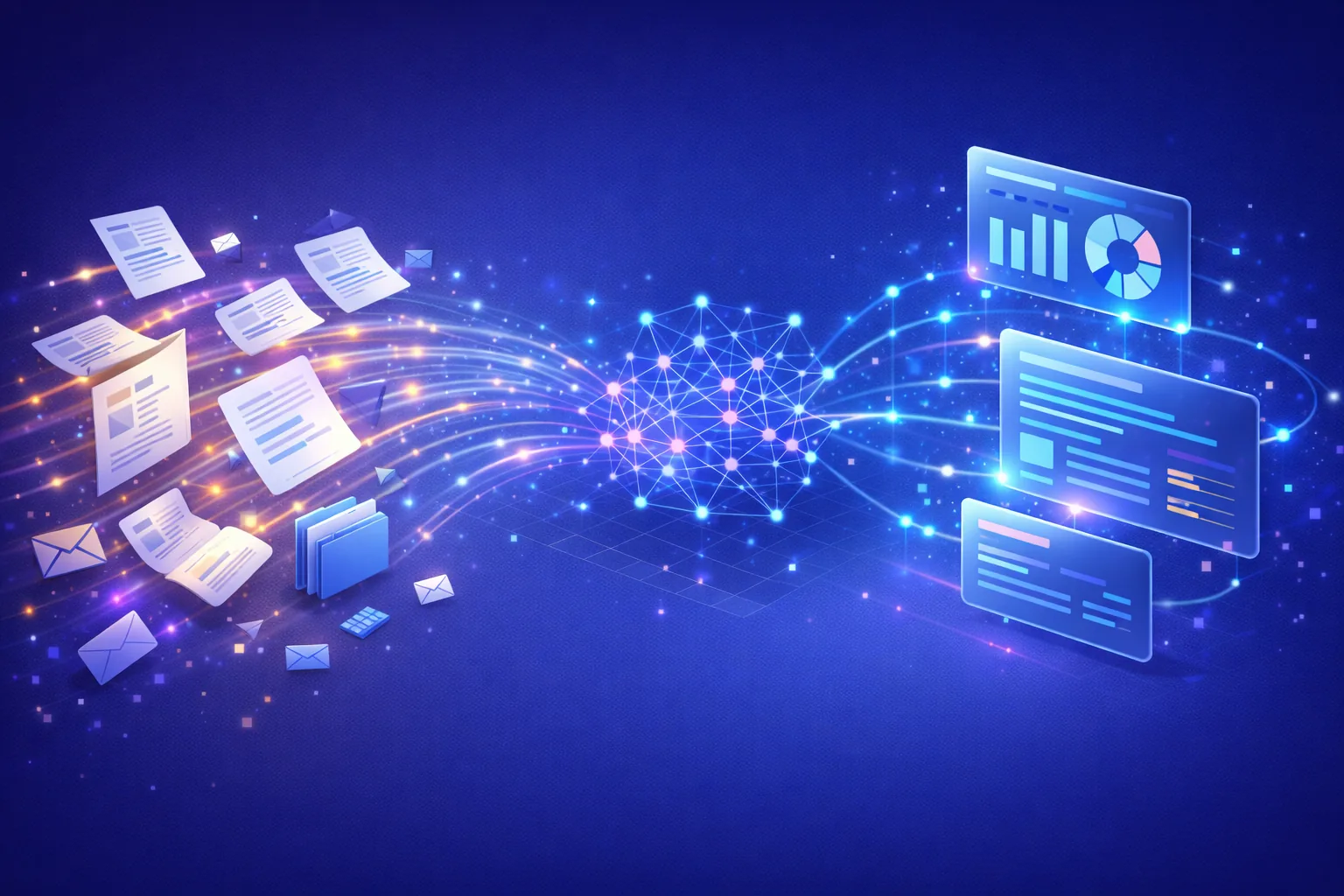
- •The system searches your documents for the most relevant passages
- •These passages are passed to the LLM along with your question
- •The LLM generates an answer based on that specific content
It's like the difference between asking an expert to answer from memory, and asking them to answer after giving them the relevant documents to consult. The second approach gives much more accurate and relevant answers.
Vectara in their report on enterprise RAG predictions explains well why RAG has become the standard for enterprise applications: it allows you to keep sensitive data in your environment, without having to send it to external services for training.
Vector Database: where "meanings" live
Ok, but how does the system find the "relevant" documents when you ask a question? Here the concept of vector database comes in.
Imagine representing every sentence, every paragraph of your documents as a point in a multidimensional space. Sentences with similar meanings will be nearby points; sentences with different meanings will be distant points.
This representation is called "embedding", translating text into numbers (vectors) that capture meaning.
When you ask a question, that too gets transformed into a vector. Then the system searches the database for the "closest" vectors, that is, the passages with meaning most similar to your question.
That's why semantic search works: it doesn't search for words, it searches for meanings. "Early termination" and "resolution before expiration" will be close vectors, even if the words are completely different.
Why should you care?
If you've made it this far, you're probably wondering: "Ok, interesting, but what do I do with this?"
Here's the practical point.
These technologies (LLM, RAG, vector database) allow you to do things that until a few years ago were impossible:
Search by concepts, not by words. "Find all contracts with exclusivity clauses" works even if each contract uses different terminology.
Ask questions in natural language. "What is the average duration of IT supplier contracts signed in 2024?", and get an answer, with references to the specific documents.
Have an "expert" on your documents. A system that has "read" your entire archive and can answer questions on any topic contained in it.
Generate summaries and analyses. "Summarize the main points of this contract" or "Highlight the differences between these two versions".
The critical point: where do these systems run?
Here's where things get interesting, and delicate.
Many AI document services work like this: you upload your documents to their cloud servers, they process them, you access the results.
For certain types of documents, this is ok. For others (confidential contracts, health data, financial information, legal case files) it's a serious problem. You're essentially handing over your information heritage to a third party.
As the European Data Protection Supervisor highlights in its analysis on RAG, GDPR requires you to know exactly where your data is, who accesses it, and to be able to guarantee rights like deletion. With cloud services, this becomes complicated.
The good news? Solutions exist that run all of this (LLM, RAG, vector database) on your infrastructure, without the data ever leaving your network.
Local LLMs: the silent revolution
One of the most interesting developments of the last two years is the arrival of LLMs that can run on local hardware.
I'm not talking about huge million-euro servers. I'm talking about compact devices, sometimes as big as a book, that can run language models powerful enough for business applications.
Open-source models like Llama and Mistral, carefully tuned and selected in-house, can run on consumer GPUs or on accessible dedicated hardware. They're not as powerful as the biggest OpenAI or Anthropic models, but for document intelligence applications they're more than sufficient.
And the advantage is enormous: your documents never leave your network. Zero dependence on external services. Zero data breach risks. Zero GDPR complications.
In practice, what does it mean?
Let me give you a concrete example of how a RAG system works for documents.
Imagine you have 10,000 contracts in your archive. The system:
- •Reads each contract and "indexes" it, creates the embeddings, saves them in the vector database
- •When you ask "which contracts provide for automatic renewal?", it transforms the question into a vector
- •Finds the most relevant passages in the contracts (those that talk about renewal, duration, expiration...)
- •Passes these passages to the local LLM along with your question
- •The LLM generates an answer: "I found 847 contracts with automatic renewal clauses. Here are the main ones..." with specific references
All this happens in seconds, on your infrastructure, without anything leaving your network.
Compare it with the traditional process: opening each contract, searching manually, compiling a list... Weeks of work vs seconds.
My advice
If you're evaluating AI solutions for documents, don't get dazzled by acronyms and marketing. Focus on three concrete questions:
Where do the models run? If the answer is "in the cloud", ask for specifics on where the servers are, who accesses them, what happens to your data. If the answer is "on your infrastructure", you've already solved half the problems.
How does the search work? Is it just keyword search or is it semantic search? Can you ask questions in natural language? Does the system cite the sources of the answers?
What's the cost model? Do you pay per query? Per document? Per user? Or do you have a fixed, predictable cost? Variable costs can explode quickly.
RAG, LLM and vector database technologies aren't buzzwords. They're concrete tools that are changing the way companies manage document knowledge. The key is implementing them the right way, which for most organizations means on-premises, under their own control.
If you want to move from theory to architecture, on the Technology page you'll find stack, components and operational logic.